Ecommerce services in Amritsar
Our ecommerce services in Amritsar help the city’s phulkari, jutti and woollen shawl sellers reach buyers who will never walk its bazaars. We run the marketplace accounts, listings, storefronts and ads remotely from Gandhi Nagar, New Delhi; stock and dispatch stay in Amritsar.

Amritsar’s crafts, and where they sell
- Known for
- Phulkari, Punjabi juttis, woollen shawls and blankets
- Craft name to check
- Phulkari is a registered geographical indication
- Festive dates
- Lohri, Baisakhi, Karva Chauth, Diwali, weddings
- Marketplaces to start
- Myntra and Ajio for labels; Amazon, Flipkart, Meesho
- Language to test
- Punjabi in Gurmukhi beside Hindi and English
- How we work
- Remotely, from Gandhi Nagar, New Delhi
Karva Chauth and Diwali move with the lunar calendar; Lohri and Baisakhi fall in mid-January and mid-April.
From the bazaar counter to the marketplace
Marketplace accounts
Myntra, Ajio, Amazon, Flipkart and Meesho run weekly: size exchanges, festive pricing, claims and settlement checks.
Craft listings that hold up
Phulkari, jutti and shawl listings that say hand or machine, name every material, and show the reverse of the work.
A storefront for your label
A Shopify or WooCommerce store for made-to-order phulkari, jutti exchanges and gifting before Lohri and the weddings.
Punjabi and English ads
Meta and Google campaigns for Lohri, Baisakhi and the wedding months, judged on orders kept after returns.
Readymade lines from Delhi
Wholesale readymade garments sourced in Gandhi Nagar, quoted by the piece and handed to your transporter for Amritsar.
In short
- Ecommerce services in Amritsar help phulkari, jutti and woollen shawl sellers reach buyers across India through marketplaces, storefronts and paid ads.
- Phulkari is a registered geographical indication, so a listing should say whether a piece is hand-embroidered or machine-made and use the name honestly.
- Jutti listings should give sizes against foot length, name the sole and upper materials, and say whether the pair is shaped for left and right.
- Amritsar sellers plan around Lohri in January, Baisakhi in April, the autumn festivals and the Punjabi wedding season.
- We work with Amritsar sellers remotely from Gandhi Nagar, New Delhi, and our garments arm supplies readymade lines from Delhi by the lot.
Our ecommerce services in Amritsar are for the shops and workshops selling the city’s phulkari, juttis and woollen shawls, which want buyers beyond the visitors who walk its bazaars. We run the accounts, listings and ads online; your counter, stock and dispatch stay in Amritsar.
Amritsar is known for phulkari embroidery, Punjabi juttis, and woollen shawls and blankets. Visitors to the city buy all three in the old city’s bazaars, and many shops take orders by phone and messaging app from buyers who have since gone home.
Selling online starts from that habit and makes it systematic: a listing that answers the questions a visitor would ask at the counter, a size chart instead of a try-on, and photographs that show the stitching up close.
We run brands of our own as well. For an Amritsar seller, commissions, returns and ad costs belong in the account review. Our only office is in Gandhi Nagar, New Delhi; Amritsar sellers work with us remotely, through user access, shared reports and calls.
Who buys Amritsar’s crafts online, and how?
Three kinds of buyer order Amritsar’s crafts online: visitors who want another pair or dupatta, Punjabi families across India buying for weddings and festivals, and shoppers who have never been to Punjab but like the look. Each finds you differently.
- Returning visitors search for the city’s name with the product, such as Amritsari jutti, and often buy again from a shop they remember.
- Families buying for occasions shop before Lohri, Baisakhi, Karva Chauth and the wedding months, often for several people at once.
- Style-led shoppers find phulkari and juttis on fashion marketplaces and social media, and compare them with everything else in the category.
The first two groups know what they are looking at and notice when a piece is not what it claims. The third relies on the listing for everything, which is why plain words about the work matter more online than across a counter.
The messaging-app orders many shops already take are a start, not a system. Moving the same range into listings or a storefront gives each piece a fixed description, a price that includes freight, and a record of who bought what.
Some orders come from Punjabi families abroad. Selling outside India brings export paperwork, its own GST treatment and separate marketplace programmes, so settle it with your adviser before you start; this page deals with buyers in India.
Which marketplaces suit phulkari, juttis and shawls?
Myntra and Ajio suit Amritsar labels with styled photographs of suits, dupattas and juttis; Amazon and Flipkart suit juttis and shawls searched by size, colour and occasion; Meesho suits value, machine-embroidered pieces. Hand-embroidered phulkari often needs room to tell its story, which a storefront gives.
| Channel | Suits from Amritsar | Watch for |
|---|---|---|
| Myntra | Phulkari suits, dupattas and juttis from a label | Brand approval, size charts, on-model imagery |
| Ajio | Ethnic labels with a defined look | Category approval and image standards |
| Amazon | Juttis and shawls searched by size and colour | Footwear size variations and BIS checks |
| Flipkart | Festive juttis and shawls before Lohri and Diwali | Sale-event pricing and stock by size |
| Meesho | Value juttis and machine-embroidered dupattas | Returns on size and thin margins |
| Own storefront | Hand-embroidered phulkari, made-to-order pieces | Paid traffic and prepaid payment |
Footwear behaves differently from textiles on every marketplace. Each jutti size is a variation with its own stock, a broken size run stops a design converting, and returns over fit are common, so the account needs stock by size watched weekly.
Our pages on selling clothes online in India and selling footwear online in India cover those two categories in depth.
Hand or machine: what a phulkari listing says
A phulkari listing has to say how the embroidery was made, by hand or by machine, what it is worked in, and on what cloth. Buyers who know phulkari check the reverse; buyers who do not rely on the words.
Traditional phulkari is darned in silk floss on hand-woven cotton, worked from the reverse of the cloth; a bagh covers the whole ground in embroidery. Contemporary pieces are often stitched over an outline printed with wooden blocks, and machine embroidery copies the look for less.
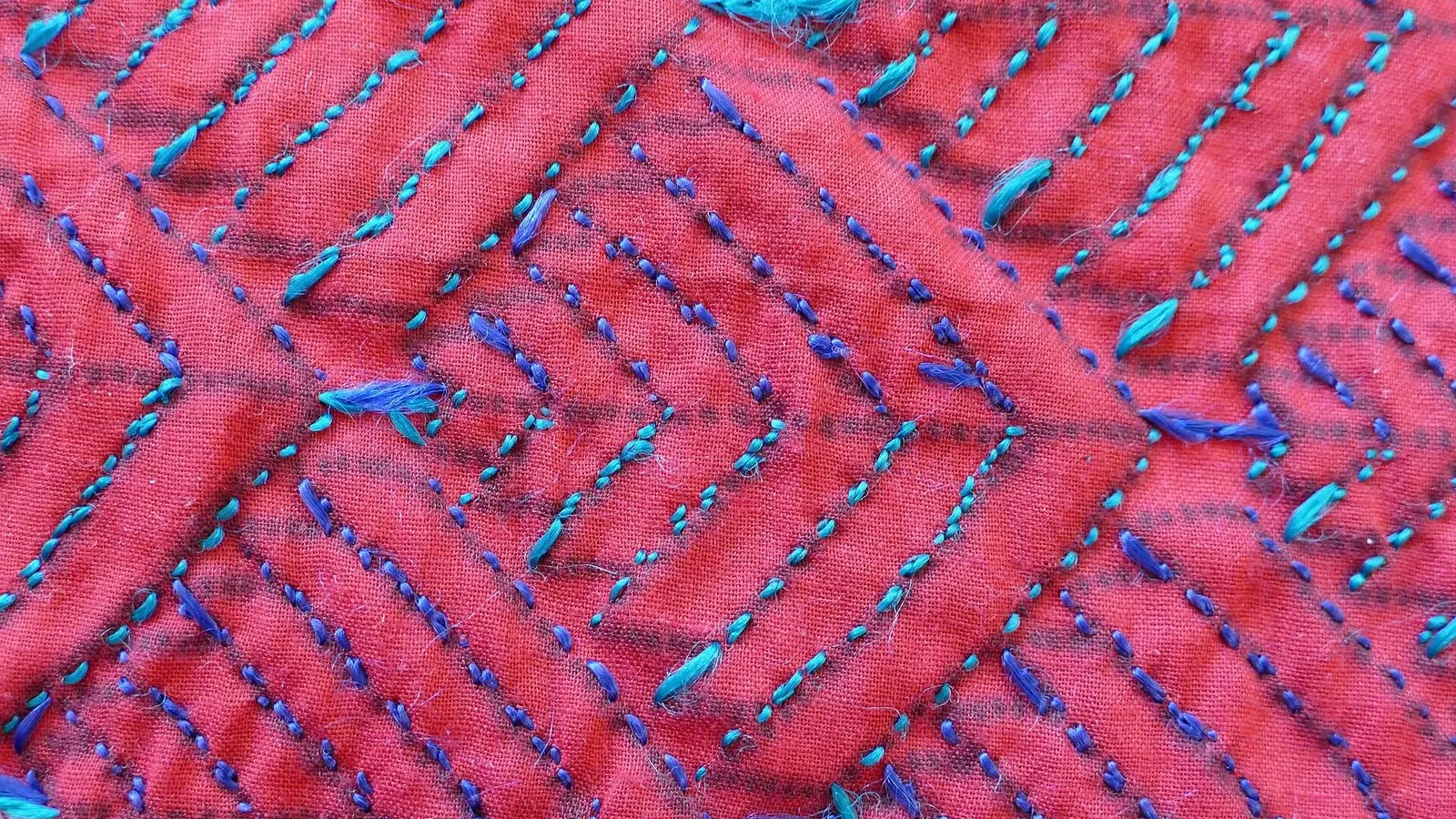
Phulkari is a registered geographical indication, so the name belongs to work that meets its registered description. Describe a machine-made piece by what it is, a machine-embroidered dupatta with a geometric pattern, and leave out phrases such as phulkari-style.
- Method. Hand-embroidered or machine-embroidered, in the title, not only in the description.
- Thread and ground. Silk floss, cotton or synthetic thread, on cotton, georgette, chiffon or a blend, as the maker states it.
- Coverage. Scattered motifs, a border, or a bagh with the ground fully covered; show the whole piece spread out.
- Size and weight. Dupatta length and width, and whether a heavily worked piece is heavy to wear.
- Care. Dry clean or gentle hand wash, and whether the colours may run.
A bagh sells to a different buyer from a lightly worked dupatta. It is bought for weddings and to keep, and judged on how dense and even the work is, so photograph it whole and then a corner in close detail.
Photographs carry the proof: the front and the reverse side by side, a close-up of the stitch in daylight, and the dupatta draped on a model so its length reads. Our catalogue and listing work builds these fields from your maker’s notes.
Juttis online: sizes, soles and the first wear
A jutti listing has to answer what a shopper would learn by trying the pair on: the size against foot length, how the pair is shaped, what the sole and upper are made of, and how it feels for the first few days.
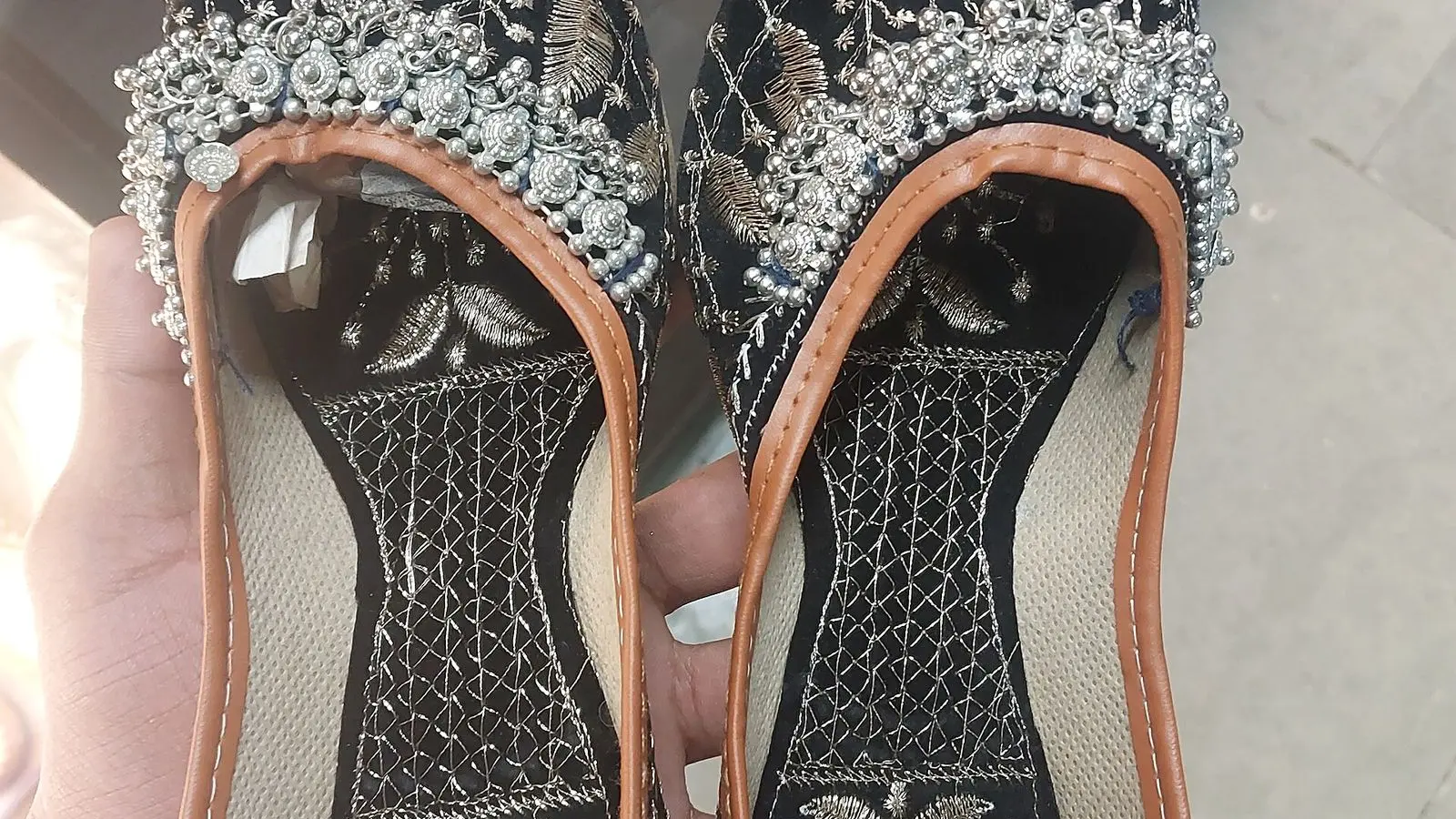
- Left and right. Many traditional pairs are made straight, with no left or right, and take the shape of the foot with wear. Say so, or a buyer may think the pair is faulty.
- Sizes. Measure foot length for each size from your own pairs, because jutti sizes do not always follow shoe sizes, and say whether the fit runs narrow.
- Soles. Leather soles can slip on smooth floors until they wear in; say whether yours are leather or rubber.
- Uppers. Leather, velvet or fabric, and the work on them: thread embroidery, metallic tilla, beads or mirrors.
Show the toe from the side as well as from above. Men’s pairs often have a raised, curled toe and women’s are flatter and lighter, and a buyer choosing for someone else needs to see which shape is coming.
Some footwear falls under BIS quality control orders, so check whether an order covers your juttis before you list them, and keep any licence details where a marketplace can ask for them.
Juttis are often bought as gifts, so pack each pair in a box that protects the embroidery and the toe, with tissue between the shoes. A crushed toe or a snagged thread on arrival reads as a fault, whatever the cause.
Woollen shawls, lois and blankets from Amritsar
Amritsar’s woollen trade sells shawls, stoles, blankets and the loi, the large woollen wrap Punjabi men wear in winter. Online, each needs its size, weight and fibre stated, because a shopper cannot feel the wool or see how far it reaches.
Name the fibre exactly as the label gives it, wool, a wool blend or acrylic, and leave premium names such as pashmina or merino to pieces whose yarn documents support them. Kashmir Pashmina, for instance, is a registered geographical indication of its own.
- Size. Length and width in centimetres and inches; a loi and a blanket can look alike in a photograph.
- Weight. In grams, because buyers judge warmth by it and compare it across listings.
- Work. Plain, a woven pattern, or embroidered borders, with the embroidery described as hand or machine.
- Gifting. How the shawl is packed, if it is sold as a gift, with the packaging photographed.
Shawls and blankets sell in the cold months, and the north’s winter is short. Listings should be live with ratings before the first chill, with a clearance plan agreed before Lohri, when the season starts to turn.
Our page for Ludhiana sellers covers Punjab’s knitwear and winter season in more depth.
Planning Lohri, Baisakhi and the wedding months
Amritsar’s selling calendar runs on Punjab’s festivals and its wedding season: Lohri in mid-January, Baisakhi in mid-April, Teeyan in the monsoon, Karva Chauth and Diwali in the autumn, and weddings through the winter. Each wants different stock, listed before the date.
| Occasion | What Amritsar sellers list | Live by |
|---|---|---|
| Lohri, mid-January | Shawls, juttis, festive suits, gifts for a first Lohri | December |
| Baisakhi, mid-April | Bright suits, phulkari dupattas, men’s kurtas and juttis | March |
| Teeyan, in the monsoon | Phulkari dupattas and festive suits | Before the monsoon |
| Karva Chauth and Diwali | Festive suits, juttis and gift shawls | Before the festive sale events |
| Wedding months | Bagh and phulkari for brides, juttis for the family | Before the season opens |
Wedding orders bring their own work. Families buy for several people at once, ask for matching colours, and need delivery before a fixed date, so wedding listings should show what can be matched and when an order must be placed to arrive in time.
Festival gifts sent too late come back. Once a parcel can no longer reach the buyer before Lohri or Baisakhi, stop promising delivery for the day and move the creative from the festival to the season.
Our page on selling festive gifts online plans the gifting dates month by month.
Should your ads run in Punjabi as well?
Test it, because many of your buyers read Punjabi in Gurmukhi script, and creative in their own language can stand out among English ads. Run it beside English and Hindi versions, and keep the one that brings orders that stay.
The platforms handle language differently. Google matches Search ads to the language they are written in, so a Punjabi ad group needs ads written in Punjabi; Meta can still target people by the language they use in the app.
- Search terms. Buyers type craft words in English letters too, such as phulkari dupatta or Punjabi jutti for men, so English keywords stay in the plan.
- Creative. Close-ups of the stitching, the jutti on a foot, and short videos of a dupatta moving, which a still image cannot show.
- Timing. Budgets rise before Lohri, Baisakhi and the wedding months, and fall when the stock behind them runs short.
We run the campaigns through our Google Ads and Meta Ads management, reported on orders kept after returns rather than on clicks.
Why juttis and phulkari come back
Juttis usually come back over size and comfort; phulkari comes back over colour, weight or the discovery that the embroidery is machine work. Wedding and festive pieces also return worn, after the occasion, which needs evidence to claim.
| Return reason | Listing fix | Pack or process fix |
|---|---|---|
| Too tight or too loose | Foot-length chart and a fit note | Exchange offered for size |
| Hurts at first | A note that pairs soften with wear | — |
| Not handwork as expected | Method stated in the title | — |
| Colour differs | Daylight photographs, colour checked | — |
| Worn after a wedding | — | Tamper-evident tags; packed orders photographed |
| Embroidery snagged | — | Tissue and a box sized to the pair |
Each marketplace sets its own return window and claim rules. Packing stays with your staff, to guidance we write, and we file the claims with your photographs inside each marketplace’s time limit.
What a jutti order costs you online
A jutti sold online carries more than its making cost: commission and fees, a protective box, freight both ways on every exchange, advertising, and TCS held from the payout until claimed. A counter price rarely covers all of it.
- Exchanges. Each size exchange means two more parcels, so a clear size chart pays for itself quickly.
- Boxes. A box adds weight and bulk, and freight is charged on both; choose the smallest box that protects the toe.
- Sale events. Festive discounts are funded by you, so decide in advance which designs can carry one.
- TCS. Tax collected at source under GST, held from each marketplace payout and claimed back against your GST.
Before a design is priced or advertised, we work out what it leaves you: making cost, each channel’s fees, the box and freight, and an allowance for exchanges from your history. A design with no room for a discount sits out the sale events.
Shawls and phulkari follow the same arithmetic with different weights. A heavy bagh or a wool blanket costs more to ship than a jutti, and a returned wedding piece may need cleaning before it can be sold again.
When an Amritsar label needs a storefront
An Amritsar label needs its own storefront when it sells hand-embroidered pieces that take a long time to make, takes orders for matched wedding sets, or has buyers who come back each season. Marketplaces suit ready stock; made-to-order work needs a page of its own.
- Made-to-order phulkari with the making time stated on the page and prepaid payment, because a custom piece is hard to resell.
- Matching sets for wedding families: suits, dupattas and juttis chosen together, with sizes for each person.
- Jutti exchanges handled as exchanges for another size rather than refunds, where your policy allows.
- Punjabi pages for the occasions, Lohri and Baisakhi first, beside the English store.
Our D2C storefronts on Shopify and WooCommerce cover the build, payments and upkeep. The store connects to the shipping app you use; packing and dispatch stay with you.
Readymade garments from Delhi for Amritsar shops
If your Amritsar shop also sells readymade garments, our garments arm supplies them by the lot from Gandhi Nagar, the readymade-garments wholesale market in East Delhi. We source and supply; private label goes through partner units, and we buy nothing in Amritsar itself.
- Brief. The lines, quantity per style and colour, the size ratio and the date the goods must reach Amritsar.
- Sample. A sample sourced in Delhi for your approval, with a quotation by the piece, GST on its own line and freight to be confirmed.
- Lot. Assembled in your ratio once you confirm in writing, and checked against the approved sample.
- Handover. Packed in Gandhi Nagar and handed to your transporter with the tax invoice and packing list.
At the time of writing, readymade garments carry GST at 5% where the sale value is up to ₹ 2,500 a piece and 18% above it; your quotation confirms the rate. Our page on wholesale kurtis from Delhi covers the women’s ethnic lines in full.
How our ecommerce services in Amritsar run
Our ecommerce services in Amritsar run the online side of a craft business from New Delhi: listings built before each festival, sizes and stock watched weekly, returns and claims filed, settlements checked, and ads paced to Lohri, Baisakhi and the wedding months.
- Look. Your listings, return reasons, claims, settlements and the margin on each design, channel by channel.
- Fix. Method and materials stated plainly, size charts measured, shot lists written for your photographer.
- Plan. The festival calendar for the year, with stock, listings and budgets set against each date.
- Run. Uploads, pricing, exchanges, claims and ads, with a weekly report on kept orders and margin.
From you we need account access, product notes from your makers, cost sheets, stock by size, and one person who decides prices and offers. The weekly account work is set out on our page about marketplace account management in Amritsar.
The first month is mostly reading and fixing: claims still inside their time limits, listings with the method missing from the title, and jutti size charts measured again. Nothing changes on your accounts until you have approved the plan.
Choosing between ecommerce agencies for an Amritsar business? Ask each how it would describe a machine-embroidered dupatta, and how it handles a jutti that comes back for size.
Mistakes that cost Amritsar sellers sales
The costly mistakes for Amritsar sellers are about honesty and timing: work described as handmade when it is not, juttis sized by habit, festive stock listed late, and visitor prices carried online without counting commission, freight and returns.
- Phulkari in the title of machine embroidery, which draws returns and complaints.
- One size chart for every jutti, though lasts and leathers differ.
- No word on left and right, so a straight pair looks faulty.
- Lohri stock listed in January, with no ratings when buyers arrive.
- Bazaar prices copied online, before commission, freight and returns.
- Pashmina on a wool blend, or wool on acrylic.
- Wedding returns never claimed, though the pieces came back worn.
- English-only creative for buyers who read Punjabi.
To start, send your range, the channels you sell on and the festivals your buyers shop for through our contact page. We answer with questions first, then a scope and a quotation you can check line by line.
Amritsar’s crafts across our industry pages
What Amritsar sellers ask about selling online
Can I sell machine-made phulkari online as phulkari?
How do I choose jutti sizes for online buyers?
Which marketplace is good for selling phulkari dupattas?
When should I list Lohri and Baisakhi stock online?
How should I describe a woollen shawl or loi online?
What GST applies to juttis and phulkari dupattas?
Can an ecommerce agency in Delhi run my Amritsar shop’s online sales?
Do you supply readymade garments to Amritsar retailers?
Other cities we work with
- Delhi NCR
- Mumbai
- Bengaluru
- Hyderabad
- Chennai
- Kolkata
- Pune
- Ahmedabad
- Surat
- Tiruppur
- Ludhiana
- Jaipur
- Lucknow
- Indore
- Chandigarh
- Kochi
- Coimbatore
- Panipat
- Karur
- Solapur
- Varanasi
- Bhadohi
- Moradabad
- Firozabad
- Saharanpur
- Jodhpur
- Agra
- Kanpur
- Kolhapur
- Meerut
- Jalandhar
- Channapatna
- Sivakasi
- Kannauj
- Mysuru
- Srinagar
Tell us what you sell from Amritsar.
Send your range, the channels you sell on and the festivals your buyers shop for. We answer with our questions, then a scope and a quote in writing.